

For years, finance leaders have been promised that technology, automation, AI, and advanced analytics would unlock faster closes, deeper insights, and smarter decision-making. And while many teams have adopted new tools, the expected transformation hasn’t fully materialized.
There’s a reason for that.
AI can’t fix bad data.
Automation can’t fix bad data.
And even the strongest finance talent can’t overcome data that is inconsistent, incomplete, siloed, or outdated.
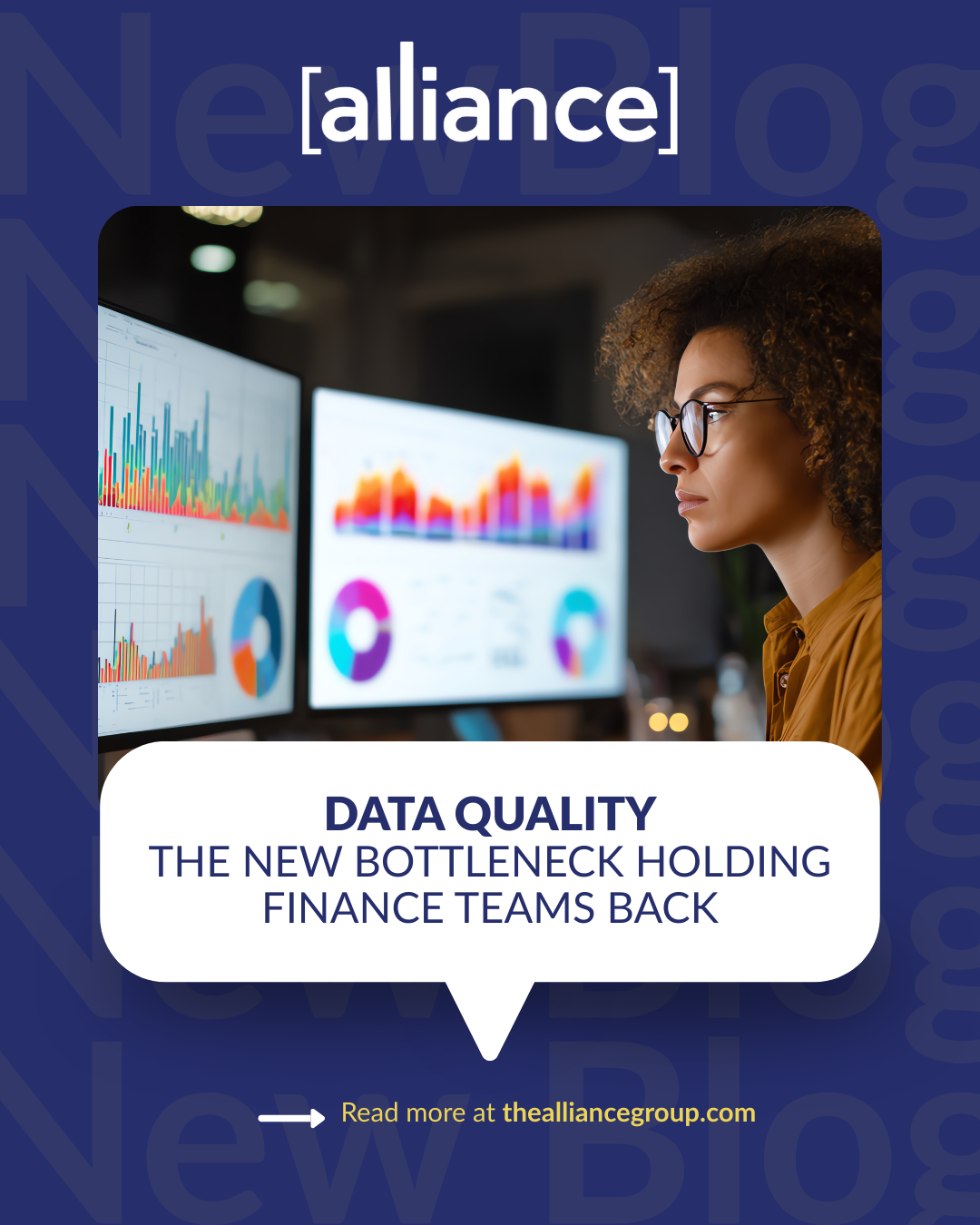
As organizations move into 2026, CFOs are realizing that data quality (not technology) is the true bottleneck standing between today’s finance function and a modernized, high-performance future.
This is the year when data governance becomes a core Finance competency.
Why Data Quality Is the #1 Barrier to Finance Transformation
Even the most sophisticated tools depend on strong, reliable data. When data is disconnected or inaccurate, it creates downstream issues across the entire Finance ecosystem, including:
- Inefficient Month-End Close Processes – Errors in source data increase reconciliations, rework, and manual adjustments, slowing the close and impacting accuracy.
- Unreliable Forecasts and Reporting – Predictive analytics and FP&A tools are only as strong as the data feeding them. Poor quality compromises visibility and confidence in decision-making.
- Challenges With Audit Readiness – Auditors rely on consistent, traceable data. Weak governance creates documentation gaps, inconsistencies, and unnecessary findings.
- Failed Automation & AI Initiatives – AI cannot interpret inconsistent naming conventions, missing fields, or poorly structured data. Automation breaks without standardized inputs.
- Difficulty Scaling Systems (Especially ERP)- ERP modernization, system integrations, and migration efforts suffer significant delays and cost overruns when data is unclean or unstructured.
Put simply:
Data issues multiply across processes, systems, controls, and people.
CFOs can no longer view data strategy as an IT responsibility; it is a Finance responsibility.
Data Governance Is Quickly Becoming a CFO-Led Discipline
Modern finance teams are shifting their thinking: Instead of asking, “What tools should we buy?” CFOs are now asking, “Do we trust our data enough to automate anything?” The organizations that will win in 2026 are the ones that embrace:
✔️ Clear data ownership and accountability – Mapping responsibilities across Finance, Accounting, IT, and Operations.
✔️ Consistent definitions and master data management – Ensuring every team uses the same terminology, structures, and standards.
✔️ Clean, connected source data – Eliminating duplicates, fixing broken integrations, and strengthening upstream processes.
✔️ Data literacy across the Finance team – Training teams to understand, validate, and steward their datasets.
✔️ Governance frameworks for AI and automation – Making sure inputs, outputs, and decision logic are transparent and controlled.
This is no longer optional; it’s essential.
How CFOs Can Start Improving Data Quality Today
Transforming data governance doesn’t require a major overhaul to get started. Finance leaders can begin with practical steps that deliver immediate and long-term impact:
- Diagnose Data Pain Points – Identify key areas where inconsistent or unreliable data slows processes or creates risk.
- Standardize Reporting Structures – Align naming conventions, hierarchies, and definitions across departments.
- Strengthen Collaboration With IT – CFOs and CIOs must be aligned on how data flows through systems and where governance needs improvement.
- Clean Before You Automate – No automation should be launched without validating upstream data accuracy and completeness.
- Build a Cross-Functional Data Stewardship Program – Assign owners, create accountability, and make data care part of day-to-day operations.
Every finance transformation (AI, analytics, forecasting, ERP modernization, automation) depends on reliable data. It’s the foundation for everything CFOs want to achieve. 2026 will be the year when high-performing finance organizations stop treating data as an afterthought and start managing it as a strategic asset.
And the teams that lead in data governance will be the ones who lead in performance, agility, and long-term value creation. Because in the modern Office of the CFO, one truth has never been clearer:
Finance can’t move faster until the data does.